Short answer:
The most consistently specified brands for type K (NiCr-Ni) thermocouple wires and sensors are WIKA, JUMO, Endress+Hauser, Heraeus and TC Limited, with B+B Thermo-Technik and Testo strong in sheathed probes and portable sensors. Bare type K wire pairs cost roughly £2 to £8 per metre, armoured stainless steel probes £12 to £40, and ceramic protection tube assemblies £60 to £250. Wire reliability comes down to alloy purity against the IEC 60584 reference tables and insulation rating; sensor reliability to sheath material, tolerance class and calibration traceability. Verified supplier profiles are listed in the directories linked below.
What are the key takeaways for sourcing K-type thermocouple wires and sensors?
- The global thermocouple market reached USD 2.07 billion in 2026, and type K holds 36.25% of revenue, making it the default industrial temperature sensor.
- Wire matters as much as the sensor: extension and compensating cables must follow IEC 60584-3 codes (KX for extension grade) with insulation matched to the environment.
- Tolerance class drives accuracy: Class 1 sensors hold plus/minus 1.5 degrees C up to 375 degrees C and plus/minus 0.4% above; Class 2 roughly doubles the band.
- The brand premium is measurable: generic imports cost 50 to 70% less but rarely ship with alloy certificates or ISO/IEC 17025 calibration.
Why do type K thermocouple wires and sensors dominate industrial temperature measurement?
Type K couples a Chromel (NiCr) positive leg with an Alumel (NiAl/NiSi) negative leg to cover minus 200 to plus 1,300 degrees C, the widest usable span of any base-metal pair. That range, combined with a nearly linear millivolt output and low material cost, explains why the pair is the default across furnaces, kilns, extrusion lines and test rigs. The global thermocouple market was valued at USD 2.07 billion in 2026, and type K accounts for 36.25% of thermocouple revenue, the largest single segment.
For buyers, the practical question is not whether to standardise on type K but which brand to trust for the wire that carries the signal and the sensor that generates it. Alloy batches that drift from the IEC 60584 reference tables, insulation that fails early, or uncalibrated sheaths produce exactly the errors that scrap furnace loads and falsify quality records.
| USD 2.07 bn | 36.25 % | Class 1 |
| Global thermocouple market value 2026 | Type K share of thermocouple revenue | Best tolerance class per IEC 60584-1 |
| -200 to +1,300 degrees C | IEC 60584-3 | £2-£400 |
| Type K measurement range | Standard for extension and compensating cables | UK price span from bare wire to furnace assembly |
Which specifications should buyers compare for K-type thermocouple wires and sensors?
Wire and sensor share the same alloy pair but fail in different ways: wire in the insulation and the connection, sensors in the sheath and the junction. The table below collects the parameters that decide field life.
| Parameter | Wire requirement | Sensor requirement |
| Conductor alloys | KP (NiCr10) positive, KN (NiSi3) negative | Same pair, welded or twisted hot junction |
| Temperature range | Minus 200 to plus 1,300 degrees C | Same, limited by sheath material |
| Insulation | PVC to 105 degrees C, PTFE or PFA to 260 degrees C, fibreglass to 400 degrees C, ceramic fibre to 1,200 degrees C | Mineral-insulated cable with compacted MgO |
| Diameters | 0.25 to 3.2 mm solid, or stranded builds such as 7/0.2 mm | Sheath 0.5 to 12.7 mm |
| Sheath materials | Not applicable | SS 316L to 800 degrees C, Inconel 600 to 1,100 degrees C, alumina ceramic to 1,300 degrees C |
| Extension code | KX thermocouple grade, KCA or KCB compensating grade | Not applicable |
| Colour code | Green positive, white negative | Same at the connector |
| Tolerance class | Class 1 or Class 2 | Class 1 or Class 2 |
| Output | About 41 mV at 1,000 degrees C | Same |
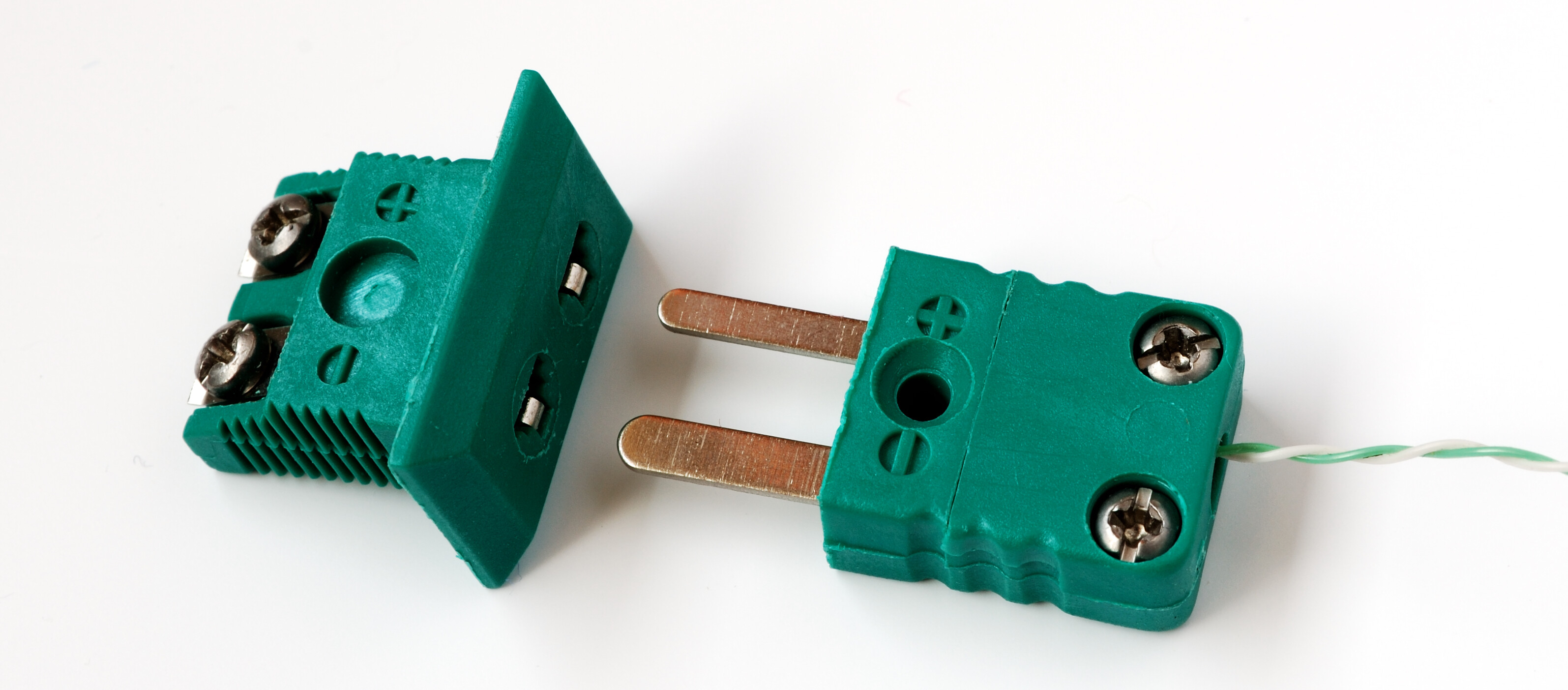
| Connector | Standard round or miniature flat plug with compensating pins | Same |
IEC 60584-1:2013 defines the EMF reference tables and tolerance classes: Class 1 holds plus/minus 1.5 degrees C from minus 40 to plus 375 degrees C and plus/minus 0.004 times the measured temperature above that, while Class 2 allows plus/minus 2.5 degrees C. For the wire, IEC 60584-3:2021 fixes the identification system, colour codes and limits for extension and compensating cables, so the signal path from junction to instrument stays within tolerance end to end.
Which brands are most trusted for K-type thermocouple wires and sensors?
Brand choice splits into two questions: who draws the alloy wire reliably, and who assembles and calibrates the finished sensor. The table below lists the brands most frequently specified by UK and European process engineers and calibration laboratories.
| Brand | HQ / Founded | Strength for wires and sensors |
| WIKA | Klingenberg, Germany / 1946 | TC10 and TC15 thermocouple families, in-house wire processing, UKAS-traceable calibration laboratories |
| Endress+Hauser | Reinach, Switzerland / 1953 | iTHERM assemblies with replaceable inserts, TAF16 high-temperature sensors to 1,100 degrees C |
| JUMO | Fulda, Germany / 1948 | One of the broadest catalogues: screw-in, surface and multipoint sensors plus matching transmitters |
| Heraeus Nobleloc | Hanau, Germany | High-purity Chromel and Alumel wire for laboratory and semiconductor applications |
| TC Limited | Uxbridge, UK | Mineral-insulated type K assemblies, AMS 2750 approved, extension cables and connectors |
| B+B Thermo-Technik | Donaueschingen, Germany / 1984 | Sheathed type K probes with standard and miniature connectors, ISO 9001 production |
| Testo | Titisee-Neustadt, Germany / 1957 | Portable type K probes and handheld instruments for flue gas and surface measurement |
Each brand leads in a different quadrant: WIKA and Endress+Hauser in process-grade assemblies, Heraeus in bare wire purity, TC Limited in UK-based custom builds. Beyond these names, a dedicated listing of thermocouple wire suppliers groups European producers and distributors by product range for direct comparison.
Where can buyers find verified K-type thermocouple wire and sensor suppliers?
The suppliers below were verified on their platform profiles in October 2026 and carry type K wires, sensors or both as core lines. Each profile lists product families, certifications and contact details for quotation requests.
| Supplier | Location / Founded | Core range |
| TC Limited | Uxbridge, UK | Mineral-insulated type K assemblies, extension cables, connectors, AMS 2750 approved |
| Endress+Hauser | Huningue, France / 1953 | iTHERM temperature assemblies, TAF11 and TAF16 high-temperature sensors |
| METRICS GmbH | Hagen, Germany | Type K probes with stainless steel sheaths for data loggers and controllers |
| Maikontrol | Barakaldo, Spain | Custom thermocouple probes, thermowells, welded fittings and cable outputs |
| ES Electronic Sensor | Heilbronn, Germany | Custom type K sensors, high-voltage variants to Class 1, short lead times |
| Elite Thermal Systems | Market Harborough, UK | Furnace thermocouples, mineral-insulated sensors, 3-zone control applications |
For buyers comparing the wider market, the thermocouple manufacturer directory aggregates additional European producers. Volume enquiries above £2,000 are best placed directly with manufacturers, while stock orders favour distributors who hold standard lengths and connectors.
Which compliance marks and standards apply to K-type thermocouple wires and sensors?
Thermocouple hardware is governed by a compact set of standards, plus product directives wherever transmitters are integrated into the assembly.
| Standard or regulation | What it covers | How to verify |
| IEC 60584-1:2013 | EMF reference tables and tolerance classes for letter-designated thermocouples | Declaration of conformity plus calibration certificate |
| IEC 60584-2:2013 | Dimensional tolerances for elements and protection tubes | Datasheet dimensional drawings |
| IEC 60584-3:2021 | Extension and compensating cable identification and limits | Cable marking and colour code |
| ATEX Directive 2014/34/EU | Assemblies with transmitters in explosive atmospheres | Certificate check via the European ATEX database |
| ISO/IEC 17025 | Calibration laboratory competence and traceability | UKAS accreditation certificate |
| UKEX: Equipment and Protective Systems Regulations 2016 | UK equivalent for hazardous area equipment | HSE guidance on ATEX equipment |
Bare thermocouple elements count as simple apparatus and need no ATEX or UKEX marking, but any assembly with a head-mounted transmitter does. For calibration, UKAS-accredited laboratories issue certificates traceable to national standards, and UK buyers typically require one with every production-critical batch.
What do K-type thermocouple wires and sensors cost in 2026?
The reference prices below reflect UK trade pricing in 2025-2026, ex VAT, drawn from platform listings and manufacturer list prices. Construction type, sheath material, length and calibration options move the price far more than the brand itself.
| Product | Reference price | Note |
| Bare type K wire pair, per metre | £2-£8 | Class 1 or Class 2, PVC to fibreglass insulation |
| Extension cable, per metre | £1.50-£6 | KX grade, IEC colour code |
| Armoured probe, SS 316L | £12-£40 | Standard or miniature connector |
| Inconel 600 sheath probe | £30-£120 | Furnace duty to 1,100 degrees C |
| Ceramic alumina protection tube assembly | £60-£250 | To 1,300 degrees C |
| Multipoint furnace thermocouple | £110-£400 | Several junctions at defined depths |
| Portable probe with display | £25-£95 | Handheld spot measurement |
| Thermocouple connector pair | £2-£8 | Compensating pins, standard or miniature |
Generic imports run 50 to 70% below these bands. The saving is real, but it buys unverified alloy composition, thinner sheaths and no certificates. For process-critical points, the total cost of ownership calculation almost always favours a calibrated branded sensor.
How do budget and premium K-type thermocouple wires and sensors compare?
| Dimension | Budget (generic import) | Premium (branded) |
| Price per item | £1-£15 | £12-£400 |
| Alloy certificate | Rarely provided | Batch traceability per IEC 60584-1 |
| Insulation | PVC only, or unrated | PTFE, fibreglass or ceramic fibre rated for the application |
| Tolerance class | Class 2 or unmarked | Class 1 available, certificate included |
| Calibration | Factory test or none | ISO/IEC 17025 with measured EMF values |
| Service life at high temperature | 200-500 hours, unverified | 2,000+ hours, documented |
How do buyers source reliable K-type thermocouple wires and sensors in six steps?
| 1 | Define the specification. Type K, temperature span, sheath material and length, connector type, tolerance class, and for wire the insulation grade and spool length. |
| 2 | Fix the compliance baseline. Hazardous area or not (ATEX or UKEX), calibration certificate required, material certificates for food or aerospace duty. |
| 3 | Shortlist suppliers. Compare the brands above, then browse supplier listings for stockists of the exact construction you specified. |
| 4 | Request compliance evidence. IEC 60584-1 conformity, calibration certificates, alloy material test reports and dimensional drawings for the exact article number. |
| 5 | Compare prices and terms. Match quotations against the reference bands, clarify VAT, carriage and tiered pricing for volumes above 100 pieces. |
| 6 | Confirm logistics and compatibility. Check connector type and colour code against existing instrumentation, and agree delivery lead times for custom builds. |
What other questions do buyers ask about K-type thermocouple wires and sensors?
Q: What is the maximum temperature a type K thermocouple can measure?
A: The nominal range is minus 200 to plus 1,300 degrees C per IEC 60584-1. Continuous operation above 1,100 degrees C accelerates alloy drift and embrittlement, especially in reducing atmospheres or vacuum. For sustained use above 1,100 degrees C, type S (to 1,600 degrees C) or type B (to 1,800 degrees C) noble-metal pairs are the safer choice, while ceramic protection tubes let type K run to 1,300 degrees C for shorter campaigns.
Q: What is the difference between KX and KCA/KCB extension cable?
A: KX cable uses the same Chromel-Alumel alloys as the sensor itself, so its EMF output matches type K over the full ambient temperature range. KCA and KCB use cheaper alloys that replicate the type K characteristic only over a limited span, typically 0 to 150 degrees C. KX is the right choice for long runs and variable plant temperatures; compensating grades are acceptable for short instrument runs where the junction box stays cool.
Q: Can a type K sensor be used with an instrument set for a different thermocouple type?
A: No. Each letter type has a unique EMF curve, and a type K sensor on a type J, T or S input reads wrong by tens of degrees. Most modern controllers and transmitters support several types and can be reconfigured in software; verify the setting before commissioning.
Q: What is green rot, and how does it affect type K wires and sensors?
A: Green rot is the degradation of the Chromel positive leg in reducing or inert atmospheres between roughly 700 and 1,000 degrees C. Chromium oxidises preferentially, producing a green corrosion film and a negative measurement drift of 10 degrees C or more within a few hundred hours. High-purity alloys, protective atmospheres or switching to type N (NiCrSi-NiSi) mitigate the effect.
Q: How often should type K sensors be recalibrated?
A: In continuous duty above 800 degrees C, annual recalibration is common practice, with six-monthly checks for critical processes. UKAS-accredited laboratories compare the sensor against reference standards traceable to national measurements and issue a certificate with measured EMF values and uncertainty. Buyers should request the initial certificate with delivery and set a recalibration schedule in their quality system.
Q: Are branded type K sensors worth the premium over generic imports?
A: Branded European sensors typically cost two to five times more than generic imports. The difference buys controlled alloy composition, rated insulation and sheaths, Class 1 certificates and documented stability data. Where a failed sensor can scrap a furnace batch worth thousands of pounds, the premium pays for itself; for non-critical, easily accessible points, generics remain a defensible choice.
Find K-type thermocouple wire and sensor suppliers directly: compare verified company profiles in the thermocouple wires directory and the thermocouples directory on europages and request quotations with calibration certificates.
Where do the facts and sources in this article come from?
- Market Growth Reports, Thermocouple Temperature Sensors Market 2026-2035 - marketgrowthreports.com
- Future Market Insights, Thermocouple Temperature Sensors Market Outlook 2025-2035 - futuremarketinsights.com
- QYResearch, Thermocouple Extension and Compensating Cable Market, 2026
- IEC 60584-1:2013, Thermocouples, EMF specifications and tolerances - webstore.iec.ch
- IEC 60584-3:2021, Thermocouples, Extension and compensating cables - webstore.iec.ch
- European Commission, ATEX Directive 2014/34/EU - atex.ec.europa.eu
- UK Health and Safety Executive, ATEX equipment guidance - hse.gov.uk
- Supplier profiles verified October 2026
